Dengue Fever
Dengue mosquito-borne viral infection that affects billions of people across more than 129 countries, with millions of cases each year. While most patients recover with mild symptoms, there is a small risk of developing fatal severe dengue.
There is no direct treatment for dengue. The only available treatment path is careful monitoring for severe dengue symptoms such as dangerous changes in blood pressure. When warning signs are detected early and clinical interventions such as organ support, mortality can fall from over 20% to under 1%.
The difficulty is that patients can deteriorate rapidly, while continuous monitoring is often expensive, invasive, and labour-intensive. During an outbreak, clinicians are left with a difficult trade-off:
- Admit patients for close observation, consuming scarce beds and clinical resources
- Discharge lower-risk patients and accept the possibility that deterioration may be missed
Neither option is ideal. D-SCAPE is intended to address this issue.
The Resource Allocation Problem
If you think about it, dengue management is fundamentally a resource allocation problem.
During outbreaks, hospitals, particularly in low- and middle-income countries, may need to monitor large numbers of patients with limited beds, staff, and equipment. Yet only a fraction of those patients will ultimately develop severe disease.
Conventional monitoring techniques like repeated blood sampling and frequent bedside observations are effective but difficult to scale. They require trained staff, equipment, and repeated clinical interaction, placing additional pressure on already constrained healthcare systems.
The opportunity is to separate where a patient is monitored from how closely they can be monitored.
D-SCAPE
D-SCAPE, short for Dengue Shock Classification and Prediction Wearable, is a monitoring platform developed by Imperial College London's Centre for Bio-Inspired Technology. This device allows lower-risk patients to recover at home while still giving clinicians timely visibility into signs of deterioration.
Instead of relying on blood tests, D-SCAPE uses photoplethysmography (PPG). PPG sensors shine light through the skin and track blood-volume changes to extract physiological signals such as pulse waveforms. The same principle powers pulse-oximeters commonly used in clinics. Commercial alternatives are often expensive, but D-SCAPE uses off-the-shelf sensors with an ESP32, reducing total hardware cost to under $100.
The first generation of D-SCAPE included:
- Two multi-wavelength PPG probes attached to the finger and wrist
- Dedicated acquisition hardware sampling signals at 1 kHz
- A laptop-based interface for real-time visualisation
It proved the concept, but it was still wired and required a dedicated laptop.
My Thesis Work
My thesis focused on building the software infrastructure to enable D-SCAPE to go from a lab demonstrator to a production-ready monitoring platform.
This meant being able to:
- Collect high-frequency physiological data wirelessly
- Store and process continuous streams of medical data
- Provide clinicians with a modern real-time monitoring platform
My work spanned across three layers:
- Embedded device: The ESP32 continuously acquires PPG signals and transmits data wirelessly via MQTT publish-subscribe messaging.
- Data pipeline: The backend combines Mosquitto (device messaging), FastAPI (application logic), InfluxDB (high-frequency physiological time series), and MySQL (patient and device metadata). This architecture ingests biosignal streams while keeping the system flexible for future analytics and machine-learning workflows.
- Clinician interface: I built a React dashboard that supports live PPG plots, monitoring of multiple connected devices, and historical signal review.
Presenting the Work
The full system was demonstrated live to faculty and researchers at Imperial College London, streaming data end-to-end from sensor to dashboard in real time.
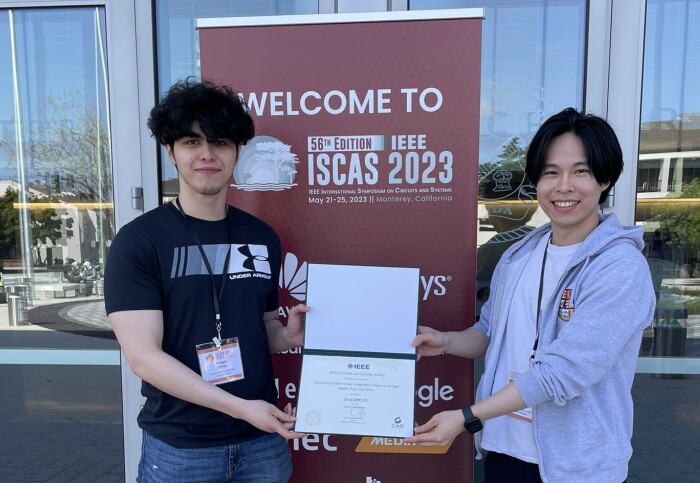
The project was later entered into the IEEE student design competition and selected as the winning regional entry for Africa, Europe, and Central Asia. That led to me and my teammate presenting the work in Monterey, California at the IEEE International Symposium on Circuits and Systems (ISCAS), to an audience of researchers and engineers in biomedical devices and signal processing.
It was a strong indication that scalable remote patient monitoring is a shared global challenge, and that low-cost sensing plus modern software infrastructure can make feasible deployment realistic. The project was also quite popular amongst private companies and I was offered a startup role after the demonstrations to continue my work.
The Future: Deployment
By the time I handed over the project, preparations were underway for deployment in a hospital in Vietnam, one of the regions heavily affected by dengue outbreaks.